 Posted by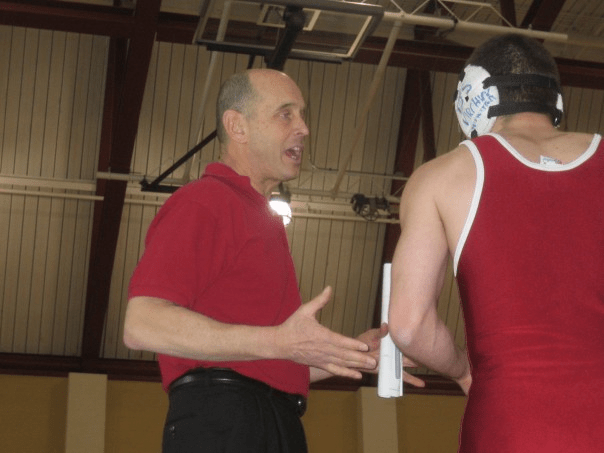
You’re ready.
The voice of Coach Ward reverberates throughout the Palaistra. He closes the door behind him and flicks the lightswitch. The lights take time to warm up, so for now we can only see him through a dim and hazy darkness. He hobbles over towards us as assertively as a wrestling coach with a double hip replacement possibly can.
We’ve just performed our ritual. It’s this thing we do after the last practice before the wrestling meet the next day. If I told you about it, I would be betraying the many years of this tradition as it has been passed down from teams before us. It does involve a speech by our captains.
Some of us have easy matches. Some of us have tough matches. Some of us have what Coach Ward called “a bag of sticks” match. He liked to joke about how people would break sticks if being choked to death by a snake so that the snake would mistakenly think it was breaking bones and loosen its grip. The joke was that you should take a bag of sticks with you to the match because you were almost certainly going to lose. All I can say is that the tension in the room is lifted when we hear the confidence in Coach Ward’s voice.
We’re ready.
You’re ready.
I wake up and the car is filling up with smoke. My legs are trapped underneath the steering column. I realize what has happened: I fell asleep and crashed into a tree. And then the more sinister thought enters my mind: I’ve survived the initial crash, but now I am going to suffocate to death. In a mad panic, I try to work open the door, but it is jammed against the tree. Choking on the smoke, I somehow nestle my legs free and dive into the backseat. From there, I crawl out the back door. Across the street, a worried couple is rushing towards me and calling an ambulance. I’m in shock.
Just a month prior, a friend of mine, Michaela, had died in a car accident. For the next year, I am racked with survivor’s guilt. Should it have been me – and not her – who died?
You’re ready.
My friend Eddie knocks on the door of my dorm room. I open it and see that he is alone. It’s early in the morning. I already know what this means – I’ve been rejected.
He comes into the room and we both sit down. He explains to me what happened and how he tried to stop it. He reiterates how sorry he is.
All I can think about is the rejection. I’ve been sequestered away from all of my friends. My social experience in college is reduced to me eating all of my meals in solitude. This is all some form of social punishment for me quitting the wrestling team, the same team I had walked on to to begin with. I immediately pack my bags and leave campus. I call my cousin in North Jersey and see if he can host me for the weekend. I cannot be around while everyone is celebrating.
You’re ready.
I couldn’t believe she had broken up with me. She came over and sat down and told me everything that was wrong about our relationship, and everything that was wrong with me. For the past year, we had spent every single day together. I had not seen it coming. I cried all night.
Months later, I decided I needed a radical change. I moved to New York City and started over again for a tech startup.
You’re ready.
New York City is a lonely place. I feel anonymous. I make very little money in a very early stage startup. I have no concept of what my future may be. I have little for a social life, and I’ve gained some weight. I am depressed.
With time, things change. I get into running and Brazilian Jiu-Jitsu. I meet my future wife. The company grows, and I build a name for myself.
You’re ready.
I’m out for the evening in the city when I get a phone call from my mother that my grandfather had died. I had been considering making a trip to see him the night prior, so now I feel guilty that I did not. My mother re-assures me that I would not have wanted to see him the way he looked.
I go home from dinner and burst into tears.
You’re ready.
With the flick of a switch, I’m packing my bags and rushing to the rental car agency to get out of NYC. The COVID-19 pandemic is sweeping through the city and trucks are being filled with cadavers. My then girlfriend and I decide to spend some time at my parents’ house in Cape Cod. It’s pretty remote and isolated this time of year. A very far cry from the life I had built up over the last seven years. I was proud of everything I had accomplished, and in the blink of an eye, it was suddenly gone.
As the pandemic rages, so does some level of paranoia inside me. It’s a weird time and everyone seems to be down each other’s throats. Everyone I know is calling each other names. Racial tension reaches a peak. I’m starting to feel angry and sad.
You’re ready.
I’m running my first ever Boston Marathon and thinking about how Coach Ward was an avid marathon runner. He could run them in under three hours.
In Mile 11, I start to get horrific muscle spasms in my legs. I will later find out that I was suffering from rhabdomyolysis, a potentially life-threatening condition that presents itself in the form of muscle spasms. The pain is unlike anything I have ever experienced before.
Thinking about how much regret I had from quitting at wrestling, I will myself forward for over 15 miles. Along the way, spectators can see the convulsions in my calf muscles. When I do cross the finish line, I’m disappointed to have not accomplished the goal I had set out for myself. I had worked so hard and even though I finished, I did not accomplish what I had set out to do. I feel like an abject failure.
For the next week, I can barely walk. When I see the doctor, she tells me I am lucky I did not end up in the emergency room. As a result of all this, I need to withdraw from the New York City Marathon a month later. I feel a bit defeated.
You’re ready.
I wasn’t ready.
I received the message that Coach Ward died. I was sitting at home at my desk in the middle of a work call. I shut down my computer. I told my boss that I needed to take the rest of the day off. Even though I only spoke to him from time to time at this point in my life, I felt that a part of me had died in that moment. Just a few months prior, I had seen him at a dinner. I got to introduce him to my fiancee, now my wife. He was going to be on the invite list for the wedding. He was in rough shape physically but mentally he was still the same exact caring and thoughtful person. He cared about every single boy he taught and coached. He had sacrificed so much for me – for all of us – and now he was gone.
You’re ready.
I wake up to the news of the largest slaughter of Jewish people since the Holocaust. I see the images and hear the stories about pregnant women’s bellies being cut open and babies being burnt alive or beheaded in their cribs. My wife and I are in New York City celebrating a babymoon before the birth of our daughter, but the news is so distressing that we need to end the trip early and come home.
But it’s not just that day that weighs on my mind. It’s every day since then. It’s the days right after when people are celebrating the death of the Jews in major cities worldwide, including in Times Square. It’s the double standards that have been applied every single day. Just years prior, I had supported my friends when George Floyd was killed. They are nowhere to be found for me. Everywhere I look, people are pontificating on some form of justification for all of the ill happening to the Jewish people. It is something I used to joke about my grandmother saying because I thought she was being hyperbolic, but indeed she is right: “anti-Semitism is alive and well.”
I’m offered empty platitudes by some friends about how I am doing and how we should get together, but then there is no follow up. Some are even rushing to blame us for our own plight. This continues to this very day. Every day, I am enraged that no one seems to care. I’ve never felt more gaslit. I’ve never felt more alone than how I have felt over the last year.
You’re ready.
A couple weeks ago, my grandmother fell. I had been traveling for work and her condition seemed to be deteriorating. I don’t want to make the same mistake I made with my grandfather, but my mother re-assures me I can wait to see her when I get home, so that is what I do.
When I arrive and she sees me, she implores my mother to have me leave.
“I don’t want him to remember me like this.”
She’s screaming in pain and agony as the nurses try to make her comfortable.
Outside in the lobby, as we overhear the screaming, I am speaking with my mother and father. I lie to them and say that maybe I should head home because she does not want me to see her like that. The reality is, I need to step outside to have a cry and I don’t want my parents to see me like that either.
You’re ready.
I’m running the Chicago Marathon on Sunday. As in all things, I have a goal time that I want to accomplish. The few marathons leading up to this one, I’ve seemed to always have some curveball thrown my way. First there was the rhabdomyolysis. The second time, I got COVID-19 two days before the race, but still managed to considerably improve my time. The last one, I almost met my goal, and probably would have had there not been a torrential downpour of rain that persisted halfway through the race to the finish.
This time, all is well, save for a sudden nagging pain I have in my arm. It’s no matter. The training is done.
When I look back at Coach Ward’s message to us, I realize I had it all wrong. I had always viewed being ready as being prepared to succeed. In hindsight, I understand the message through a different lens.
“You’re ready” was not a boost to the ego, nor was it a warning. It was an acknowledgement that we were prepared to deal with whatever life threw our way, including failure. That’s why it was OK to talk about the “bag of sticks” match. Because it didn’t matter if you lost. It mattered how you handled it.
 Jeff Kirchick